

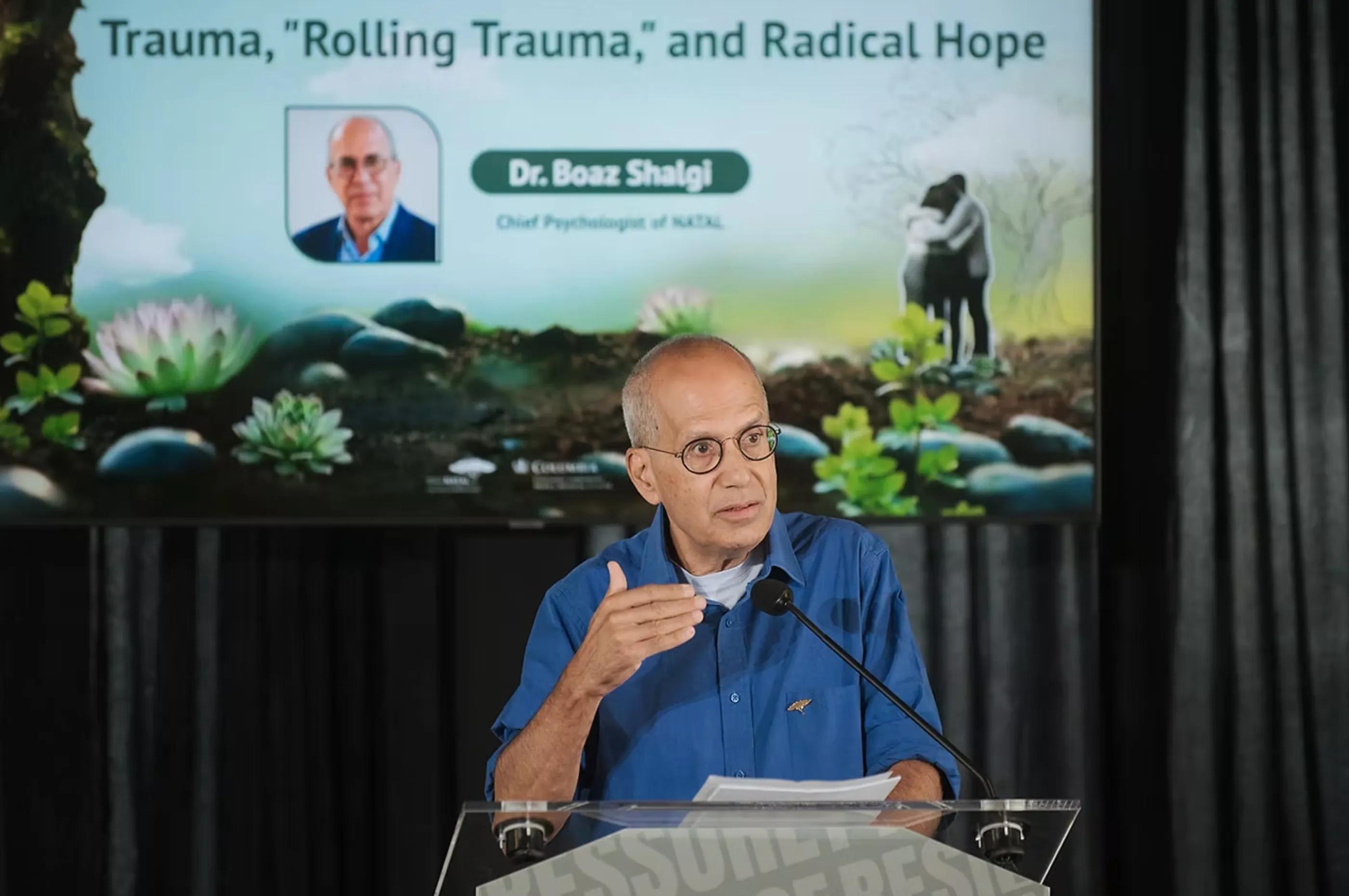
NATAL’s Dr. Shalgi detailed rolling trauma at a seminar.

On October 8, 2026, at the World Trade Center in New York City, American Friends of NATAL hosted its second annual conference, "Resilience Under Pressure," in collaboration with the Columbia University PTSD Research and Treatment Program. During the seminar, Dr. Boaz Shalgi, Chief Psychologist of NATAL, delivered a profound presentation exploring the complex dynamics of trauma, the severe impact of repeated psychological distress, and the path toward genuine recovery.
The Mechanics of Trauma: Dissociation as Survival
At its core, trauma represents an encounter between the human psyche and an experience so overwhelming that the mind simply cannot tolerate or process it. Whether resulting from a sharp external event, an ongoing struggle, or enduring circumstances, trauma creates a profound realization that one's fundamental psychological integrity and sanity are at risk.
When reality exceeds the mind's capacity to process information, individuals face a stark choice between collapse and dissociation. Dissociation functions as a crucial survival mechanism, offering an escape when no physical escape exists. By blocking the mind's ability to fully process cognitive and affective information, dissociation shields the psyche from total disintegration.
However, Dr. Shalgi emphasizes that this vital protection comes at a severe cost to the human mind. Dissociation compromises the capacity to feel and endure emotional pain, eliminates the capacity to create personal meaning from experiences, and restricts psychic movement by making the mind rigid and cautious. Over time, these disruptions lead to insulation and isolation, creating a central paradox where the very mechanism that saves the mind from immediate collapse slowly deadens its ability to engage with life.

Beyond Isolated Crises: The Weight of "Rolling Trauma"
While standard therapeutic approaches attempt to expand an individual's range of tolerance to integrate isolated traumatic memories, unique challenges arise when trauma is continuous or repetitive. Dr. Shalgi introduces the concept of rolling trauma to describe the dynamic where trauma repeatedly attacks an individual or community over time. Unlike a single bounded event, rolling trauma involves a compounding cycle where just as an individual begins to process past experiences and rebuild their life, another traumatic event strikes.
This repetitive cycle creates a devastating psychological toll. When recovery efforts are repeatedly interrupted by new crises, individuals experience a sharp escalation in depression, anxiety, and helplessness. Dr. Shalgi notes that the primary danger of rolling trauma is the relentless repetition, which erodes future expectations and fosters deep despair, leading individuals to question the utility of attempting to heal at all.

Emerging From Despair: The Nature of Radical Hope
Yet even amidst the despair induced by rolling trauma, a subtle, persistent drive toward life often remains hidden within the psyche. Dr. Shalgi draws upon the concept of radical hope to explain this survival instinct, framing it as a distinct class of hope that emerges only after traditional sources of comfort, expectations, and familiar structures have been entirely exhausted. Radical hope is grounded in a fundamental life force that activates when the threat to existence becomes extreme, operating within psychoanalytic frameworks as an instinctual power that preserves life from the absolute depths of despair.
Unlike everyday optimism, radical hope does not rely on predicting a positive future outcome or imagining a specific destination. Instead, it represents an instinctual refusal to succumb, enabling individuals and communities to endure catastrophic disruptions and eventually discover new ways of living on the other side of crisis.
Healing Through Connection: The Role of the Therapist
For radical hope to lead to true recovery rather than isolated self-preservation, human connection remains essential. Dr. Shalgi highlights that relying solely on internal survival mechanisms can lead to a solitary self-reliance that insulates the individual from others. Therefore, the therapeutic relationship plays a critical role in bringing individuals back into connection with the world.
Therapists working with rolling trauma must go beyond standard observational roles. To help individuals transition from mere survival back into active engagement with life, practitioners must be willing to enter the challenging emotional terrain alongside their patients, confronting deep fear and loss together. By directly acknowledging profound pain within a shared human bond, individuals learn that their experiences do not have to isolate them permanently, making it possible to restore trust, rebuild meaning, and navigate even the most daunting impacts of trauma.
ALL PHOTOS: Ben Kelmer